

Football season means one thing for millions of fans every week: checking the NFL schedule today to see which teams are playing, what time kickoff is, and which channel to turn on. With thirty-two teams spread across the league and games running from Thursday night through Monday night, keeping track of the NFL schedule can feel like a full-time job on its own. This guide breaks down how the weekly schedule works, what to expect from the 2026 season, and the easiest ways to stay on top of every kickoff without missing a single down.
What’s Happening in the NFL Schedule Today
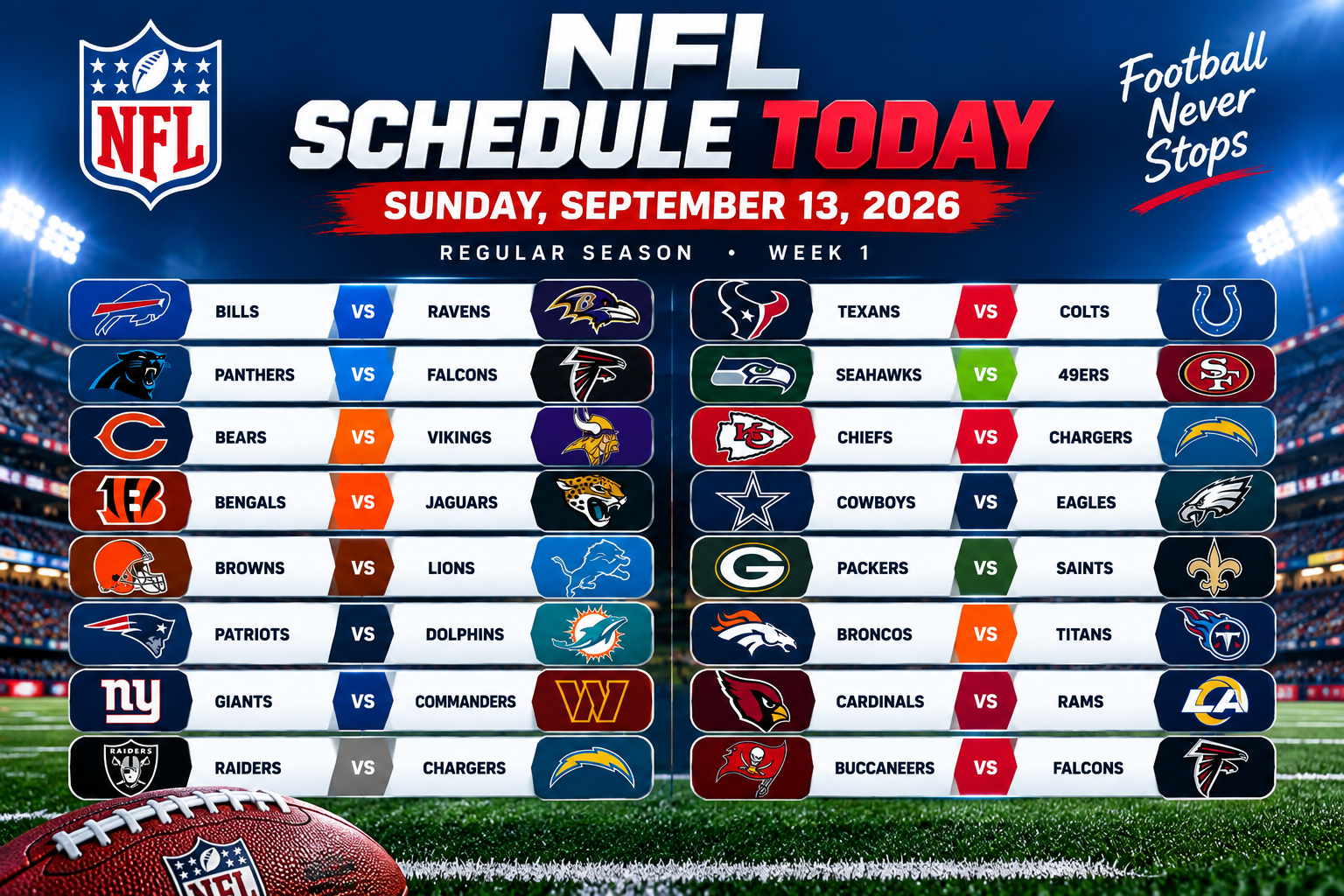
The 2026 NFL season kicked off on September 9, with reigning Super Bowl champion Seattle hosting New England in the traditional NFL Kickoff Game, followed by a Thursday night matchup between San Francisco and the Los Angeles Rams. From there, the bulk of Week 1 action shifted to Sunday, September 13, with a full afternoon slate that includes Chicago at Carolina, Tampa Bay at Cincinnati, and New Orleans at Detroit, among several other matchups spread across the early and late Sunday windows.
Monday night closes out Week 1 with Denver traveling to face Kansas City, a game that airs in the league’s marquee Monday Night Football slot. This pattern repeats every week of the regular season, with a Thursday night game, a full Sunday schedule split into early and late afternoon windows plus a Sunday night showcase, and a Monday night finale. Knowing this rhythm makes it much easier to predict what today’s schedule will look like at any point during the season.
Because the matchups and kickoff times shift from week to week, the most reliable way to confirm exactly what is on today is to check the league’s official schedule page or a major sports network’s live scoreboard, both of which update automatically as games are added, moved, or flexed to different time slots.
How the NFL Weekly Schedule Is Built
The NFL schedule is not random. The league uses a formula based on each team’s division, the previous season’s standings, and a rotation system that ensures every team plays a mix of divisional rivals, conference opponents, and a set of teams from the opposite conference each year. This formula is released publicly months before the season starts, which is why fans can already see the full slate of games for 2026 stretching from early September through early January.
Once the matchups are set, the league assigns specific dates, times, and broadcast networks. Early-season schedules are usually finalized well in advance, but the NFL reserves the right to adjust certain late-season games closer to kickoff through a process known as flexible scheduling, which allows more compelling matchups to move into better broadcast windows as playoff races heat up.
This structure means the regular season runs eighteen weeks for most teams, with each team getting one bye week somewhere in the middle of the schedule. The season itself spans from early September to early January, setting up a postseason that runs through mid-January and February before crowning a champion at the Super Bowl.
Thursday, Sunday, and Monday Night Football Explained
Thursday Night Football has become a fixture of the modern NFL calendar, giving fans a midweek game to look forward to without waiting for the weekend. These games typically kick off in the early evening and often feature teams coming off a normal week of rest, which can sometimes lead to unpredictable performances compared to standard Sunday matchups.
Sunday remains the heart of the NFL schedule, with an early afternoon window, a late afternoon window, and a Sunday Night Football broadcast that closes out the day with one of the week’s most anticipated matchups. Most fans watching NFL schedule today searches are looking specifically for these Sunday games, since the majority of the league’s thirty-two teams play during this single day each week.
Monday Night Football wraps up the football week with a standalone primetime game, a tradition that dates back decades and remains one of the most-watched weekly sports broadcasts in the country. Together, these three windows give fans football on four of the seven days each week during the regular season, which is part of why the league’s schedule generates so much year-round attention.
Where to Watch Today’s NFL Games
NFL broadcast rights are split among several major networks, and knowing which one is airing a particular game is just as important as knowing the kickoff time. CBS and FOX typically handle the bulk of Sunday afternoon games, split by conference, while NBC carries Sunday Night Football and ESPN or ABC typically handles Monday Night Football, depending on the season and specific scheduling arrangements in place.
Streaming has also become a major part of how fans follow the schedule. Services tied to the league and its broadcast partners now offer live local and primetime games on mobile devices, along with replays and a dedicated channel that shows whichever game has the most exciting action at any given moment. This has made it far easier for fans without traditional cable access to follow the NFL schedule today from a phone, tablet, or streaming device.
For fans who want to follow every out-of-market game involving their favorite team, dedicated out-of-market packages remain available through select providers, giving access to every Sunday afternoon broadcast regardless of local blackout restrictions. Combining one of these packages with a standard streaming subscription is typically the most complete way to never miss a kickoff.
Understanding Bye Weeks and Schedule Changes
Every team in the league gets exactly one bye week during the regular season, meaning there is a week where that team does not play at all. Bye weeks are spread across the middle portion of the schedule, so fans following a specific team should always double check whether that team is actually on the slate before assuming a game is happening on a given Sunday.
Schedule changes can also happen due to flexible scheduling, weather-related relocations, or occasionally international games played outside the United States. The league has increasingly used neutral-site games, including matchups played overseas, which can shift kickoff times significantly for fans watching from different time zones.
These changes are typically announced with enough notice for fans to adjust their plans, but it is always worth double-checking kickoff times close to game day, especially for early-season international matchups or late-season games that may have been flexed into a different broadcast window than originally planned.
How to Check Live Scores and Real-Time Updates
Beyond just knowing what time a game starts, many fans want live scores and play-by-play updates throughout the day. Official league apps and major sports websites offer real-time scoreboards that update automatically, showing the current score, quarter, and time remaining for every game in progress at once.
These tools are especially useful on Sundays, when multiple games are being played simultaneously across different time zones. A single glance at a live scoreboard can show a fan exactly how their team is doing without needing to switch between broadcasts, which has become a standard part of how modern fans consume the NFL schedule today.
Fantasy football players in particular rely heavily on these real-time updates, since roster decisions and lineup changes often depend on live scoring data rather than waiting until a game has finished to check results.
Tips for Following the NFL Schedule All Season
The easiest way to stay on top of the NFL schedule is to bookmark a reliable source and check it regularly, since kickoff times, networks, and even matchups can shift as the season progresses. Setting reminders ahead of a favorite team’s game day is a simple habit that prevents missed kickoffs, especially during weeks with unusual scheduling like Thursday games or international matchups.
Following team-specific schedules rather than trying to track the entire league at once can also make things more manageable for casual fans. Most official schedule pages allow users to filter by team, which narrows down the information to only the games that matter most to that fan without the clutter of every other matchup happening that week.
Finally, understanding the broader structure of the season, including bye weeks, flex scheduling, and the eventual shift toward the postseason in January, makes it much easier to anticipate changes before they happen rather than being caught off guard by a shifted kickoff time or an unexpected day off for a favorite team.
Conclusion
Keeping track of the NFL schedule today does not have to be complicated once the underlying structure of the season is understood. From the Thursday night opener through the Sunday afternoon windows and the Monday night finale, the league follows a consistent weekly rhythm that repeats from September through early January. Combining that knowledge with a reliable source for live updates, whether through an official app, a major sports network, or a streaming service, makes it simple to stay current on every game without missing a moment.
Whether the goal is catching a favorite team’s kickoff time, planning a Sunday around the day’s biggest matchups, or simply staying informed heading into the playoffs, understanding how the NFL builds and adjusts its schedule gives fans a real advantage. With the 2026 season now underway, following these patterns week to week is the most reliable way to never miss what is happening in the league.
