

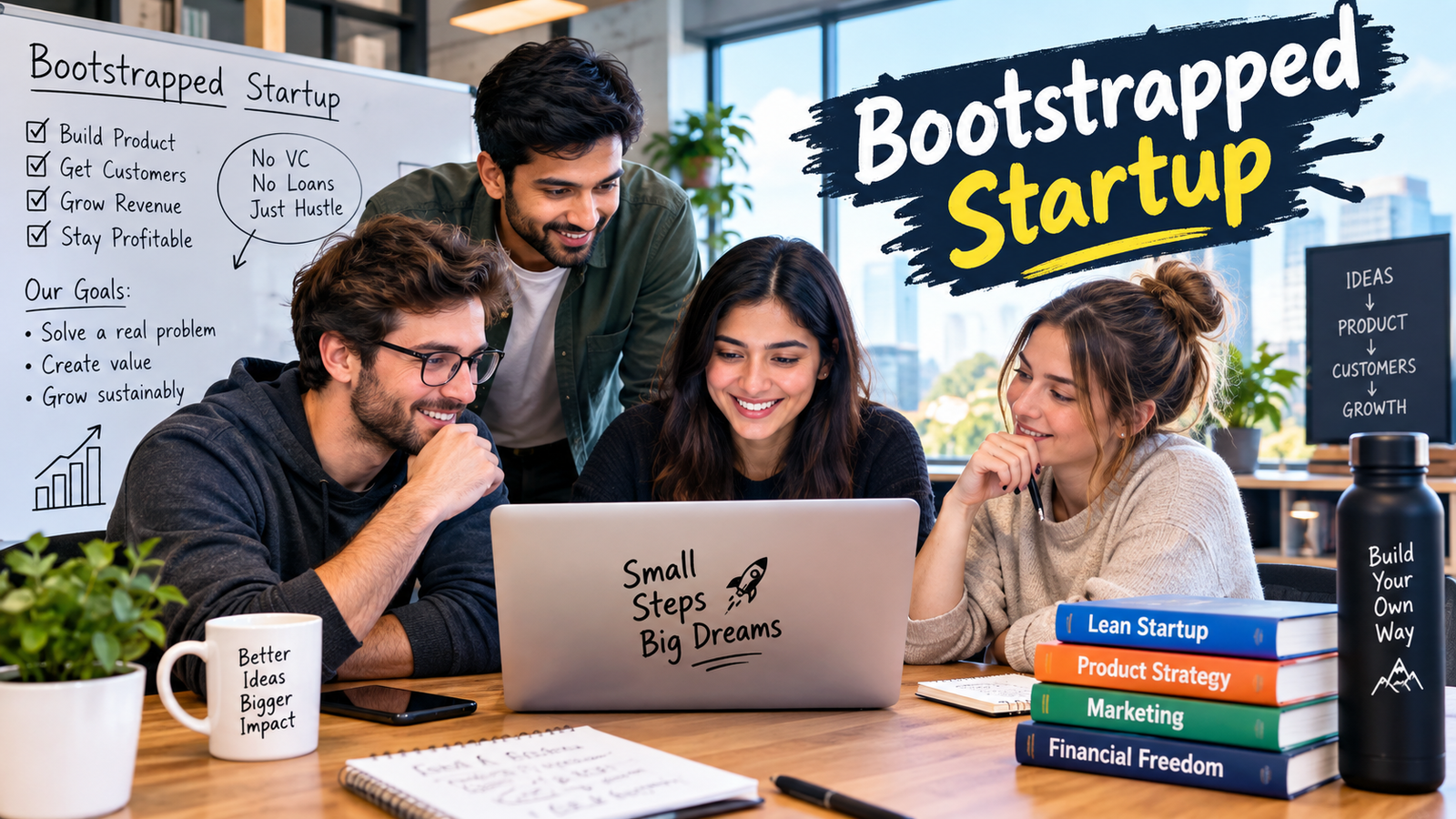
Starting a Bootstrapped Startup company without investors sounds risky, yet it is how most businesses begin. A bootstrapped startup grows from the founder’s own savings and the money customers pay. More people now see it as a serious choice because it offers control, full ownership, and steady progress. This guide explains what bootstrapping means, what recent research says about it, and how to do it sensibly. Along the way you will see real numbers, well-known examples, and honest trade-offs, so you can decide whether self-funding fits your idea.
What Is a Bootstrapped Startup?
A bootstrapped startup is a business funded mainly by the founder’s own money and the revenue it earns. There are no venture capital firms or angel investors at the start. Every dollar spent has to be justified, because there is no outside cushion if a plan fails. The term comes from the old saying about pulling yourself up by your own bootstraps.
Bootstrapping is about how a company is financed, not how big it can grow. Some founders stay small and profitable on purpose, keeping a healthy income and a flexible life. Others grow into large companies and only accept outside money later, from a position of strength. Both paths count as bootstrapping in the early years, and both rely on the same habits: careful spending, close contact with customers, and patience.
How Common Is Self-Funding Today?
Self-funding is far more common than most headlines suggest. Gallup-based figures often cited in startup research say about 77% of founders use personal savings as their most common funding source. Other surveys say roughly 77% of startups are first funded by savings and credit cards, and that only about 0.05% ever raise venture capital. Some estimates say 75% to 85% of early-stage startups are bootstrapped. The exact share changes by country and by how a study counts, but the message is steady: most founders start on their own money.
The cost of starting also matters. One 2026 startup statistics roundup puts the average cost of launching a business at around $40,000, though this varies widely by industry. The same roundups say around 90% of startups eventually fail and that only about 18% of first-time founders succeed. Treat these as broad estimates, not promises, because definitions of “failure” and “success” differ from study to study.
Why More Founders Are Choosing This Path
Recent reports suggest a real shift toward customer-funded growth. A 2025 founder salary report, cited in Ramp’s bootstrapping guide, found that about 18% of founders in venture-heavy hubs like New York and San Francisco were self-funding, a 77% increase from the year before. Data from Stripe Atlas points the same way: only about 2.2% of Atlas startups raised money within three months of incorporating, down from 3.1% in 2024.
Investor behavior helps explain this. Global venture funding reached about $425 billion in 2025, and about 1,705 companies now hold billion-dollar valuations. Yet much of that money clusters around large AI rounds and elite technical teams. Founders outside that narrow group are finding that revenue, lower spending, and full ownership are more reachable goals than a big funding round. Keeping equity also means keeping decisions about pricing, hiring, and when to sell.
How to Fund the Early Stage
Most bootstrapped founders begin with personal savings, a day job, or freelance work that covers living costs while the business grows. Carta data suggests founders commonly put in around $10,000 and spend roughly four to six months building the foundation before looking outward. Other reports put early personal investment between $10,000 and $30,000. Your own number depends on your industry, but the habit matters more than the amount: decide how much you can afford to lose before you start, and write it down.
Customers can also fund the company. Founders increasingly start with service revenue, consulting income, paid pilots, and pre-sales, using that cash to build the real product. Charging early has a second benefit, because it proves that people will pay. Be careful with credit cards and personal loans. Interest and personal guarantees can turn one slow quarter into a serious problem, so keep a separate emergency fund and track how many months of runway you have left.
Building a Product People Will Pay For
Bootstrapped founders rarely have the budget to chase a broad market, so a narrow focus works best. A 2026 review of self-funded winners found they shared a few traits: they chose a narrow, painful problem, cared more about profit and customer retention than flashy numbers, and treated revenue as their only funding round. That advice is simple, but it is easy to ignore when a big idea feels exciting.
Before you build much, talk to at least a few real buyers. Ask how they solve the problem today, what it costs them, and what they would pay to fix it. Then build a minimum viable product, which is the simplest version that solves the core problem, and show it to early users. Their feedback will show you what to improve and what to drop. Extra features cost time and money, and a small product that customers renew is worth more than a large one nobody asked for.
Managing Cash and Costs
Cash flow is the lifeline of a self-funded company. Track your burn rate, meaning the money you spend each month, along with your customer acquisition cost and how long customers stay. If winning a customer costs more than that customer brings in, growth will drain the business instead of feeding it. Reports on self-funded companies often note that they tend to spend less to win customers and reach profit sooner, though this varies by business.
Simple habits protect cash. Hire slowly and use freelancers first. Ask for annual payment upfront when customers agree. Send invoices promptly and follow up on late ones. Cancel software you no longer use. Review your books every month instead of once a year, and consider a good accountant early. Clean records also build trust with lenders, partners, or future investors.
The Role of AI, No-Code Tools, and Small Teams
Modern tools have lowered the cost of starting. One 2026 survey summary says 78% of founders report that AI tools have already reduced their operating costs, and another source says about 60% of new startups use no-code or low-code tools. The no-code market reached about $28.11 billion in 2024, growing at roughly 27.6% a year. In one survey, about 80% of founders using no-code tools said they plan to bootstrap, which suggests these tools mainly help self-funded builders.
Teams are shrinking as a result. One startup report puts the average team size at around 4.3 people. Carta found that solo founders made up 36.3% of new startups in the first half of 2025, up from 23.7% in 2019. Tools help, but they do not replace judgment. Review AI-generated work before customers see it, protect customer data, and use the time you save to talk to buyers and improve support.
Real Success Stories and Honest Risks
Mailchimp is a well-known case. It grew for about two decades without outside investors and was acquired by Intuit in 2021 in a deal reported at about $12 billion. Atlassian grew for years mostly on customer revenue before going public in 2015. Midjourney is reported to be self-funded and was estimated to have reached around $500 million in annual recurring revenue by 2025 with a team of roughly 40 to 60 people. Revenue figures like these are estimates, and success stories suffer from survivorship bias, because we rarely hear about the many self-funded companies that quietly closed.
The risks are real. Growth can be slower, and personal savings are exposed. Research cited by the National Bureau of Economic Research suggests venture-backed companies create about 4.2 times more jobs over their lifetime than bootstrapped ones. Carta also found that solo-led startups received only 14.7% of cash raised in priced equity rounds in 2024, even though they made up about 30% of startups founded that year. Founders can also burn out when one person handles product, sales, and support. Set clear checkpoints, keep fixed costs low, avoid depending on one large customer, and ask mentors for advice.
Conclusion
Bootstrapping is not a shortcut, but it is a proven and increasingly popular way to build a business. The research points to a clear pattern: most founders start with their own money, more are delaying outside funding, and cheaper tools make it easier to test ideas with a small team. The strongest self-funded companies focus on a narrow problem, charge early, watch their cash, and grow at a pace they can support.
It also has limits, including slower growth and personal financial risk, and some businesses do need investors from the start. If you choose to bootstrap, plan carefully, set your limits in advance, and treat every customer as your best source of funding and feedback. This article is general information, not financial or legal advice, so speak with a qualified accountant or attorney before taking on debt or selling equity.
