

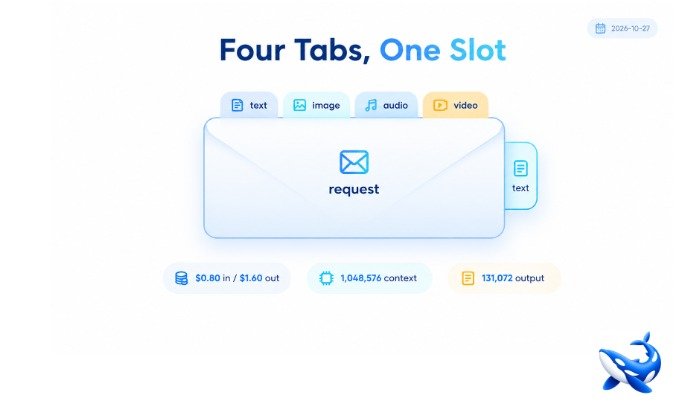
Through OrcaRouter the MiMo V2.6 Flash abliterated API takes the same shape as every other endpoint on the key, and the shape is worth reading before the benchmarks. Four input modalities — text, image, audio, video — one output modality, text. A 1,048,576-token context and a 131,072-token output ceiling at $0.80 in and $1.60 out per million [OURS].
Those five lines decide more integrations than any score does, because they determine whether your evidence can go in at all.
The request shape
The endpoint speaks the standard chat-completions shape, so an OpenAI-compatible client works by pointing the base URL at the gateway. Three capabilities are advertised alongside the modalities: vision, audio, tools, JSON, reasoning [OURS].
In practice that means:
- Images and frames go in the same message array as text, as typed parts.
- Audio goes in as a file part, not as a transcript you produced yourself.
- Video goes in the same way, and the model samples it internally.
- Tools are defined in the request and emitted as calls.
- JSON is requested through the response format, with a schema if you have one.
The output is text in all cases. There is no image generation, no audio synthesis, no rendered artefact.
What the four modalities are for
Each input corresponds to a kind of evidence that other pipelines drop.
| Modality | What it carries |
| Text | Source code, logs, reports, tickets |
| Image | Dialogs, dashboards, diagrams, screenshots |
| Audio | Calls, voicemail, meeting recordings, dispatch |
| Video | Screen captures, recorded sessions, CCTV |
The last two are the ones almost no security tool accepts. Whether they matter to you depends entirely on where your evidence arrives, and that is a question about your intake process rather than about the model.
The context and the ceiling
A million tokens of context is the largest in the family alongside the text-only cards, and it is what makes a repository-plus-logs request possible in one call.
The output ceiling of 131,072 is a third of what the DeepSeek-based sibling offers, and it is the card’s tightest constraint for report generation. A comprehensive audit with evidence blocks and remediation steps can exceed it; a summary plus a findings table will not.
Two budgets, then, not one: a generous input window and a moderate output ceiling. Plan the artifact to the second.
Where the integration actually breaks
Three failure points, in the order teams hit them.
Media size. A ten-minute recording is not the same request as a screenshot. Whatever the encoding does to the token count, the request grows faster than people expect, and a context window that looked enormous on paper can close quickly when video is involved.
Audio quality. A call recording with background noise produces a worse transcript than a clean one, and the model has no way to tell you that it misheard.
Output truncation. A request that asks for a long report and gets cut off looks like a model failure and is usually a ceiling failure. Check the finish reason before blaming the model.
Each has a cheap mitigation: segment the media, prefer clean recordings, and cap the requested length below the ceiling.
The access step
Like every OrcaCyber card, this endpoint requires an engagement, a passkey and acceptance of the terms before it serves a request [OURS]. That is a step in the integration plan, not a detail — a client that works against a test endpoint without the passkey will fail in production.
What the page does not tell you
Production behaviour. The card was released 2026-10-26 and its measured volume is 23,103,765 tokens — enough to show the endpoint works, not enough to characterise it [OURS]. Latency and throughput figures exist on the page; treat them as early.
The honest position is that the API shape is clear, the modalities are clear, and the behaviour under your own load is unknown until you test it. That is normal for a card this new, and it is the reason the first integration should be a probe rather than a migration.
Errors you will meet first
Four failure classes, in the order an integration hits them.
Payload too large. Media is the usual cause. The error arrives before generation starts, which is the good news: you have not paid for tokens.
Unsupported part type. A client library that does not know how to serialise an audio part will fail locally, not at the gateway. Read the library version before blaming the endpoint.
Truncated output. Not an error at all — a `length` finish reason with a shorter answer than requested. This is the failure that reaches production, because nothing throws.
Expired passkey. The gate’s credential has a lifetime, and a rotation that misses a deployment shows up as a 401 on every request at once.
Logging the finish reason and the error type separately is the difference between a diagnosable pipeline and one that “sometimes doesn’t work”.
Retries and what they cost
At $0.80 and $1.60, a retry is cheap enough that the policy should be generous — with one exception.
Retry on 5xx and on timeout. The request may not have been billed at all, and the second attempt often succeeds.
Retry on truncation with a smaller ask. Not the same request: reduce the requested length, or split the artifact.
Do not retry on a malformed request. A 400 for an unsupported part will fail identically every time, and a retry loop just burns the rate limit.
Three lines of policy, and they cover almost every case a new integration encounters.
One more: log the model string with every request. A pipeline that switched cards during a migration and cannot tell which response came from which build is a pipeline that cannot explain its own results.
The takeaway
Four inputs, one output, a million-token window and a 131,072 ceiling at eighty cents and a dollar sixty. The shape is unusual only in the modalities, and everything else is the standard contract your client already speaks.
Read the ceiling carefully before you plan the artifact, and read the access gate before you plan the timeline.
One closing note on scope: the API contract tells you what the endpoint accepts, not what it is good at. Those are different documents, and this card’s second document is still being written by its first users — including you, if you deploy it now.
Sourcing note: modalities, capabilities, context window, output ceiling and prices are from the OrcaRouter model page, checked 2026-10-27 [OURS]. The 23.1-million-token weekly volume is OrcaRouter production telemetry for the seven days ending 2026-10-26 and is a short sample because the card is one day old [OURS]. No benchmark rows are used in this article.
