

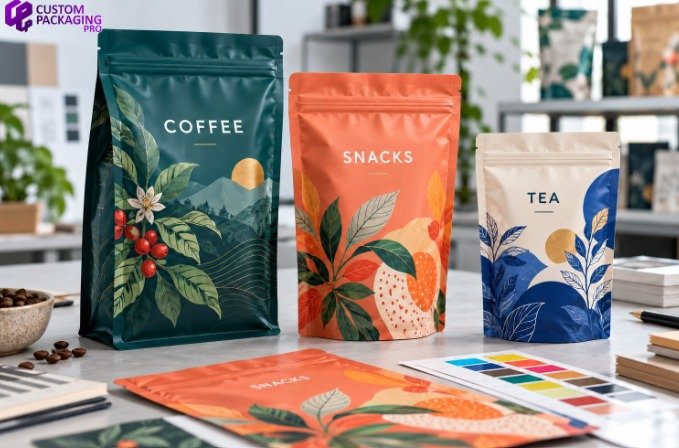
A printed pouch can look impressive while lying flat and become difficult to read once filled. Graphics disappear into the gusset, a zipper leaves less usable space than expected, or the finished material produces colors that look different from the approved screen preview.
When planning mylar bags full color printing, businesses need to coordinate artwork with the pouch’s construction and intended use. Product capacity, material layers, seals, closures, and printing all contribute to the finished package.
Start with what the product needs from filling through customer use. A useful design provides a clear brand presentation while remaining practical to fill, seal, display, open, and store.
Define the Product Before Designing the Pouch
Custom Mylar bags should be specified around the contents rather than selected by appearance alone. Coffee, candy, powders, pet treats, and nonfood accessories can require different material and handling considerations.
Describe the product’s physical characteristics and how it will be packed. Sharp edges, fine particles, oils, and bulky shapes can each affect the specification.
Establish:
- Intended fill weight and volume
- Product dimensions or particle size
- Moisture, oxygen, and light sensitivity
- Filling and sealing equipment
- Storage and distribution conditions
- Expected customer use after opening
These details give the supplier a practical starting point for recommending a pouch structure.
Mylar Packaging Names Do Not Establish Barrier Performance
“Mylar bags” is often used commercially to describe a range of flexible pouches. The name alone does not identify every layer or establish how the finished package performs.
Likewise, foil bags and metallized pouches should not automatically be treated as equivalent.
Ask for the proposed material construction and performance information relevant to the product. Thickness can affect handling, but it does not independently establish oxygen or moisture protection.
The complete package matters, including its seals and closure arrangement. An appropriate laminate can still perform poorly if the filled pouch is damaged or inadequately sealed.
Size Pouch Bags Using Actual Fill Tests
External dimensions do not tell you exactly how much product a pouch will hold. Sealed edges, zipper placement, and gussets all affect the usable interior.
Products with the same weight can occupy very different volumes. Fine powder, whole coffee beans, and irregular snacks cannot be sized reliably from weight alone.
Fill sample pouch bags with the actual product and check:
- Usable capacity
- Space needed above the contents
- Filling access
- Zipper clearance
- Final seal area
- Filled shape
Avoid compressing the contents simply to make an undersized pouch work. Confirm that routine filling can be completed cleanly and consistently.
Stand Up Pouch Bags Need a Stable Filled Base
A stand up pouch uses a base arrangement designed to open as the package is filled. Whether it stands reliably depends on the pouch geometry, contents, and fill level.
Test the actual product on a representative shelf. A lightweight or unevenly distributed fill may behave differently from the material used in a supplier’s demonstration sample.
Check the pouch when fully packed and after some contents have been removed.
The front panel should remain readable in its normal display position. A pouch that leans heavily or folds across the product name may need changes to its dimensions, gusset, or artwork placement.
Mylar Bags Full Color Printing Needs a Defined Artwork Area
Full-color graphics should be developed on the correct production template. A generic rectangle does not show all the areas affected by seals, folds, closures, or trimming.
Confirm the dieline before positioning important elements.
Keep the brand name and product identifier within the main visible panel. Allow the supplier’s specified margins around cut lines and functional areas.
For designs extending across several surfaces, check how the graphics align after filling. A continuous pattern may tolerate movement better than a detailed image crossing a gusset.
Review the package as a three-dimensional object rather than approving only a flat layout.
White Ink and Metallic Effects Need Separate Decisions
Printing over a clear, white, or metallic substrate can produce different visual results.
Some designs use selected white backing areas to keep colors opaque while leaving other areas transparent or metallic. The intended effect needs to be identified clearly in the artwork specification.
Do not assume a color shown on screen will look identical on every material.
Ask how the printer will reproduce:
- White lettering
- Solid background colors
- Transparent windows
- Metallic-looking areas
- Small reversed text
- Brand-critical colors
Where appearance is important, review a suitable physical proof or representative printed sample before approving production.
Digital Printing Should Be Evaluated Against the Order
Digital printing may be considered for certain pouch projects, particularly where artwork versions or order quantities influence production planning. Its suitability depends on the supplier’s equipment, materials, and available processes.
Compare the proposed method against the full project requirements.
Ask about artwork preparation, color expectations, proofing, quantity per design, and repeat-order consistency. Several flavors may require separate production quantities even when they share one pouch size.
Confirm turnaround times directly for the approved specification. Design approval, material availability, printing, pouch conversion, and delivery can all affect the schedule.
Avoid choosing a process solely because it sounds faster or more economical.
Ziplock Mylar Bags and Heat Seals Serve Different Functions
Mylar zipper bags can provide a convenient way for customers to close the package after opening. A zipper should not automatically be treated as equivalent to the initial production seal.
Many resealable pouch designs combine a zipper with a separate heat-sealed area above it. The exact arrangement depends on the pouch specification.
Confirm how the bag will be filled and where the final seal belongs.
Keep product particles away from closure and sealing areas during packing. A zipper that feels closed is not evidence that the complete package meets its intended barrier requirements.
Validate the sealing process using the actual pouch and equipment.
Custom Resealable Bags Need Comfortable Everyday Use
Custom resealable bags should be tested beyond the first opening. Customers need to find the closure, separate it comfortably, and close it again without an unnecessarily complicated process.
Use representative samples to evaluate how the package opens and closes over repeated use.
Check whether the product interferes with the zipper. Powders or small particles may collect near the closure and affect its operation.
Also consider access to the contents. A narrow opening can make scooping or pouring awkward even when the pouch has sufficient capacity.
The appropriate closure is one that suits the product and intended customer experience, not simply one that looks secure.
Custom Die Cut Mylar Bags Need Functional Boundaries
Die cut Mylar bags can use distinctive outlines to support product identity or promotional presentation. However, a custom shape changes the space available for filling, sealing, and printing.
Custom die cut Mylar bags should retain practical areas for closures and the intended production seals.
Review narrow sections, projections, and corners that may complicate handling or packing. A memorable silhouette offers limited value if it reduces usable capacity excessively.
Test the filled package and its outer shipping arrangement. An unusual shape may need additional support or occupy more space than a conventional pouch with comparable contents.
Food Pouches Need Application-Specific Materials
Food pouches should be selected for their intended contents and conditions of use. A package suitable for one dry product should not automatically be used for oily, acidic, hot-filled, or frozen products.
Provide the supplier with the relevant application details and request supporting material information.
Printing and adhesives also belong in the packaging specification. The design should maintain the intended separation between the food and components not meant for direct contact.
Do not describe general Mylar food storage bags as freezer bags without confirmation of suitability.
Any shelf-life expectation should be established through appropriate product and packaging evaluation rather than inferred from the pouch name.
Storage Accessories Cannot Replace Packaging Validation
Some storage applications involve an oxygen absorber or other accessory. Such additions are not a substitute for choosing an appropriate pouch, filling process, and seal.
Whether an accessory is suitable depends on the product and storage system. Avoid assuming that adding one establishes safe long-term storage.
For commercial products, work from a validated packaging plan and qualified product guidance.
The same principle applies to claims about freshness. A resealable bag may support convenient use, but it does not independently establish how long the contents remain suitable after opening.
Keep storage instructions specific to the actual product and tested package.
Child Resistant Mylar Bags Require Verified Performance
A difficult-to-open zipper is not sufficient evidence that a pouch is child resistant.
Where child-resistant packaging is required, obtain documentation appropriate to the intended product, market, and complete package design. Confirm that the supplied specification corresponds to the evaluated configuration.
Do not replace an approved closure or change functional dimensions without checking the implications.
Customer instructions should clearly explain the intended opening and closing method.
Treat child resistance as a performance requirement requiring verification, rather than a decorative feature or general description attached to all zipper bags.
Coordinate Pouches With Retail and Shipping Packaging
A flexible pouch may still need support for transport, merchandising, or presentation.
A carton sometimes described informally as a “Mylar box” should be specified clearly: is it an outer shipping box, a counter display, or a presentation carton containing several bags?
Each serves a different role.
Check the filled pouches inside the proposed outer packaging. Excessive compression, sharp edges, or movement can damage surfaces and interfere with presentation.
For multipacks, arrange products so variants are easy to identify. Confirm whether retailers will display individual pouches, the complete carton, or both.
Mylar Bags Wholesale Need Consistent Approval Records
Before ordering Mylar bags wholesale, settle the material, dimensions, closures, artwork, and packing process.
Keep an approval record covering each product variant and the sample or proof used for comparison.
Review:
- Filled capacity
- Seal performance
- Zipper operation
- Print placement
- Color expectations
- Surface appearance
- Shipping configuration
For businesses sourcing Mylar bags in Houston, confirm delivery arrangements, proofing procedures, and communication responsibilities directly. A supplier’s location alone does not establish production timing or product suitability.
Compare complete costs, including testing, artwork changes, outer packaging, and inventory that could become unusable after a design update.
Final Thoughts
Successful printed Mylar bags combine recognizable graphics with a pouch structure suited to the contents. Material selection, capacity, sealing, and repeated opening deserve the same attention as the front-panel design.
Reviewing the wider range of Mylar and Zipper Bags can help businesses define which format to investigate. Final selection should follow actual product trials and confirmed specifications.
Custom Packaging And Printing works best when artwork and functional requirements are developed together. Clear specifications for Custom Product Packaging also make proofs, quotations, and repeat orders easier to compare.
When briefing a Custom Packaging Supplier, provide product samples, filling details, and intended storage conditions. For Custom Packaging For Small Business, an approved, practical specification can provide a stronger foundation than ordering a large quantity before the pouch has been tested.
Frequently Asked Questions
- What does Mylar bags full color printing involve?
Mylar bags full color printing applies multicolor graphics, branding, and product information to a specified flexible pouch material. The finished appearance depends on the substrate, printing process, white backing where used, and surface treatment. Artwork should follow the supplier’s approved production template.
- Are ziplock Mylar bags the same as heat-sealed bags?
No. A zipper generally allows repeated opening and closing, while a production heat seal serves a separate function in the package. Some pouches include both. Confirm the intended filling and sealing arrangement rather than assuming the zipper provides equivalent performance.
- How do businesses choose the right Mylar bag size?
Test the actual contents in sample pouches. Account for usable interior space, gussets, zipper position, headspace, and the final seal area. Product weight alone is insufficient because different contents occupy different volumes and behave differently during filling.
- Can custom die cut Mylar bags include resealable closures?
They can, where the proposed shape and construction accommodate a suitable closure. Confirm usable capacity, seal areas, filling access, and opening performance before approval. Decorative outlines should not interfere with the functional parts of the pouch.
- Are all Mylar bags suitable for long-term food storage?
No. Suitability depends on the food, laminate construction, seals, storage conditions, and validated packaging process. The product name or bag thickness alone does not establish shelf life. Obtain application-specific information and evaluate the complete filled package.
- What should brands check before ordering printed Mylar bags wholesale?
Confirm materials, dimensions, fill capacity, artwork, closure operation, and sealing requirements. Review appropriate proofs or samples and test the filled pouch. Document approved specifications, clarify production schedules, and evaluate outer shipping packaging before committing to a larger order.
