

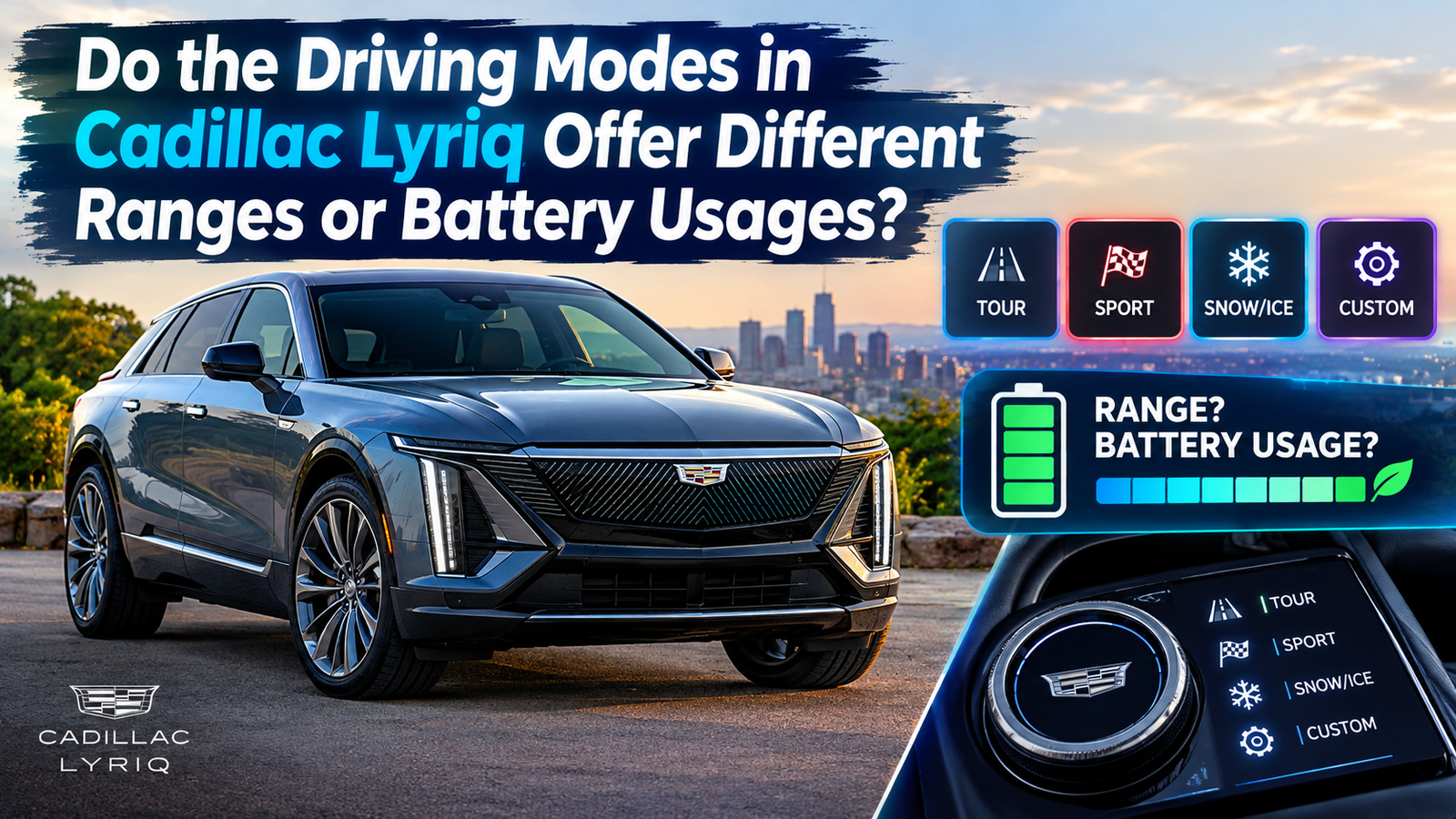
The Do the Driving Modes in Cadillac Lyriq Offer Different Ranges or Battery Usages? is one of the most popular luxury electric SUVs on American roads, and one question keeps coming up among owners and shoppers alike. Does switching between the driving modes actually change how far the Lyriq can travel on a charge? Many drivers assume that Tour Mode hides extra miles somewhere, or that Sport Mode burns through the battery in a way that cannot be avoided. The truth is more interesting and more useful than either idea. The driving modes do affect how much energy you use on a given drive, but they do not give the Lyriq separate official ranges, and they do not change the size of the battery in any way. Understanding the difference helps you plan trips better, charge smarter, and get more real miles out of the car you already own.
What Driving Modes Really Mean in the Cadillac Lyriq
Cadillac’s driving modes are software settings, not mechanical changes. When you select a different mode, nothing physical happens under the floor of the vehicle. The battery pack, the electric motors, the inverter, the brakes, and the tires stay exactly the same. What changes is the way the car reads and responds to your inputs behind the scenes.
Each mode adjusts a handful of things at once. It changes how sensitive the accelerator pedal feels, how quickly torque arrives at the wheels, how heavy the steering feels in your hands, and how the traction and stability systems react when a wheel starts to slip. In some cases it also changes the strength and feel of regenerative braking. Put together, these adjustments give the Lyriq a noticeably different personality without altering a single piece of hardware.
The standard Lyriq gives you four main choices: Tour, Sport, Snow and Ice, and a customizable setting known as My Mode. The high performance version of the Lyriq adds an extra aggressive setting on top of these. You can change between modes while you are driving, without stopping or shifting into park, and the car settles into the new calibration within a second or two.
The Battery Size Never Changes
This is the most important point to understand, and it clears up most of the confusion. The Lyriq uses a battery pack rated at 102 kilowatt-hours, and that number stays fixed no matter which mode you choose. There is no hidden reserve that Tour Mode unlocks. There is no separate portion of the pack that Sport Mode drains first. The energy available to you is identical in every mode.
The official range estimates work the same way. The single motor rear-wheel-drive Lyriq is rated at roughly 326 miles, the dual motor all-wheel-drive version comes in a little lower at around 319 miles, and the performance model sits near 285 miles. These figures come from a standardized government test cycle that does not measure mode selection at all. The number on the window sticker does not move when you press the mode button.
So the honest answer to the original question is this. The driving modes change your battery usage, not your battery capacity. Think of it like a fuel tank that always holds the same amount. How carefully you use what is inside determines how far you actually get.
Tour Mode and Everyday Efficiency
Tour Mode is the default setting, and it is the one the Lyriq starts in most of the time. It is built around smoothness. The accelerator pedal responds gently rather than sharply, torque builds gradually instead of arriving all at once, and power delivery stays predictable at both city speeds and highway speeds.
That smoothness is exactly why Tour Mode tends to deliver the best real-world efficiency. Gentle and gradual acceleration is one of the most effective ways to save energy in any electric vehicle. Because the pedal is less sensitive, you are less likely to surge away from traffic lights and less likely to make constant tiny speed corrections on the highway. Those small corrections add up over a long drive, and smoothing them out shows up clearly in your energy consumption readout.
Drivers who consistently report numbers close to the official estimate are almost always driving in Tour Mode, at moderate speeds, in mild weather. If your main goal is maximum miles between charges, this is the setting to live in.
Sport Mode and the Cost of Quick Response
Sport Mode changes the character of the Lyriq right away. The accelerator becomes far more sensitive, torque arrives almost instantly, and the steering usually firms up. On a curving road or a short highway on-ramp, the difference is genuinely fun, and it reminds you that this is a powerful vehicle rather than a quiet appliance.
That responsiveness does cost you energy, but it is worth being clear about why. Sport Mode does not make the motors less efficient at a steady cruising speed. What it does is make hard acceleration much easier and much more tempting. Every burst of strong acceleration pulls a large amount of power from the battery, and repeated bursts are what actually shorten your range.
Many owners report losing a noticeable chunk of range when they drive in Sport all the time, often somewhere in the range of ten to twenty percent compared with Tour. Those are driver observations rather than manufacturer figures, and the real variable is behavior. Drive gently in Sport Mode and the penalty is small. Drive hard in it every day and the battery will keep score.
Snow and Ice Mode in Cold Weather
Snow and Ice Mode exists for one purpose, which is keeping the Lyriq under control on slippery surfaces. It softens the throttle considerably, limits sudden torque spikes that could break traction, and adjusts how the stability and traction systems intervene. It may also moderate regenerative braking, because strong regen on an icy road can unsettle the vehicle at exactly the wrong moment.
Because it limits aggressive power delivery, this mode is not wasteful on its own. In some situations it may even reduce energy lost to wheel spin. However, the conditions that call for it are themselves the biggest range reducers in any electric vehicle. Cold temperatures slow the chemical activity inside the battery, increase internal resistance, and often limit how much regenerative braking the car will allow until the pack warms up. Cabin heating adds another steady draw on top of that.
The practical advice is simple. Never avoid this mode to save range. Safety comes first, and the small efficiency difference caused by the mode is tiny compared with the effect of the weather itself. Switch back to Tour once the roads are clear and dry.
My Mode and Personal Settings
My Mode is probably the most overlooked feature in the Lyriq, and it may be the most useful one for drivers who care about range. Instead of accepting a fixed package of settings, you build your own profile by mixing individual preferences such as steering weight, accelerator response, and regenerative braking strength.
For efficiency, the ideal setup usually means keeping the accelerator response relaxed while setting regenerative braking as strong as you find comfortable. That combination discourages sudden power spikes while recovering as much energy as possible every time you slow down. Drivers who want a sportier steering feel without the twitchy pedal can have one without the other, which is something no preset mode offers.
Spending ten minutes in the large center display setting this up properly pays off over months of driving. A well-tuned personal profile often gives you the efficiency of Tour Mode with the driving feel you actually enjoy, which makes it far more likely that you will stay in an efficient setting day after day.
Regenerative Braking and One-Pedal Driving
The Lyriq offers one-pedal driving along with a paddle on the steering wheel that lets you call up regenerative braking whenever you want it. These features work alongside the driving modes, and for most people they matter more to real-world efficiency than the mode selector does.
With one-pedal driving turned on, lifting your foot off the accelerator slows the car firmly while pushing energy back into the battery. In stop-and-go city traffic, where you are constantly slowing and speeding up again, that recovered energy adds up quickly. Drivers who learn to read traffic ahead and control speed with a single pedal routinely see better consumption numbers than drivers who coast and then brake hard at the last moment.
The steering wheel paddle adds finer control. You can scrub off speed on a long downhill grade or while approaching a slower vehicle without touching the friction brakes at all. Every time you use the friction brakes, that energy is lost as heat. Every time you use regeneration instead, part of it returns to the pack.
Things That Affect Range More Than Modes
Speed is the single biggest factor in how far your Lyriq will go. Air resistance rises sharply as speed increases, so cruising at a high speed for an hour uses far more energy than cruising at a moderate speed for the same hour. Slowing down by ten miles per hour on a long trip saves more range than any mode selection ever will.
Temperature comes next. Cold weather reduces battery efficiency and increases the energy needed to heat the cabin. Using the heated seats and heated steering wheel instead of blasting warm air through the whole cabin is a meaningful saving. Warming the car while it is still plugged in at home is one of the smartest winter habits available, because that energy comes from the wall rather than from the pack.
Beyond speed and weather, several ordinary things move the needle more than people expect. Underinflated tires increase rolling resistance. Roof racks and cargo boxes hurt aerodynamics badly at highway speeds. Heavy loads, steep terrain, and choosing the all-wheel-drive version over the rear-wheel-drive version all shift your real numbers as well.
Simple Habits That Protect Range and Battery Life
The best approach is not to pick one mode and stay there forever. Use Tour as your everyday default, save Sport for the drives where you actually want the extra response, and switch to Snow and Ice whenever traction is genuinely poor. Matching the setting to the conditions is both safer and, across a full year, more efficient than stubbornly refusing to change.
Charging habits matter just as much over the long run. For daily driving, charging to somewhere in the middle of the pack rather than all the way to full is generally gentler on the battery, with full charges saved for road trip days. Fast charging on the highway is convenient and sometimes necessary, but it produces more heat than slower home charging, so it works best as a travel tool rather than a daily routine.
Finally, build your expectations around your own numbers instead of the window sticker. Track your average energy use over two or three weeks of normal driving, including your commute and your weather. That personal average becomes a far more reliable planning figure than any published estimate, and it takes most of the worry out of longer trips.
Final Thoughts
So Do the Driving Modes in Cadillac Lyriq Offer Different Ranges or Battery Usages? The modes do not offer different ranges, because the battery capacity and the official rating never change. They absolutely do affect battery usage, because they change how power is delivered and, more importantly, how you end up driving. Tour Mode encourages the smooth habits that stretch a charge. Sport Mode invites the quick acceleration that shortens it. Snow and Ice Mode trades a little efficiency for control when the road turns slick. My Mode lets you decide where the balance sits.
The larger lesson is that the mode button is a helpful tool rather than a magic switch. Your speed, the outside temperature, your tire pressure, your use of regenerative braking, and your charging routine shape your real-world range far more than any single setting on the screen. Choose the right mode for the conditions, drive smoothly, and the Lyriq will reward you with numbers that make its official estimates look honest.
