

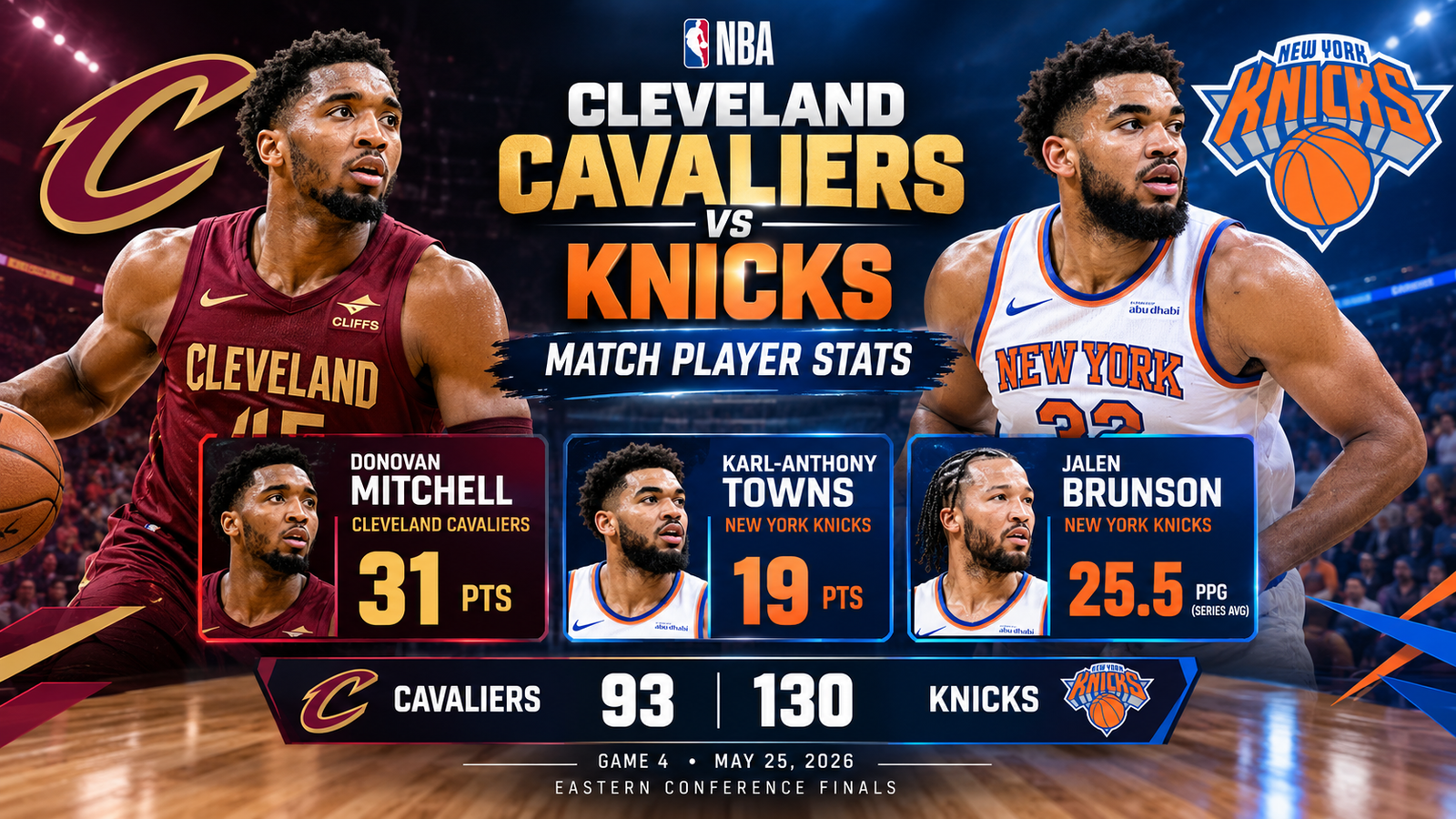
Basketball fans looking into Cavaliers vs Knicks match player stats are usually going back to one of the most talked-about series of the 2026 NBA playoffs, the Eastern Conference Finals between the Cleveland Cavaliers and the New York Knicks. This matchup gave fans strong individual performances, tight team battles, and a series outcome that shaped the rest of the postseason. This article breaks down the key player stats from the series and explains what those numbers show about both teams.
Setting the Stage for the Eastern Conference Finals
The Cavaliers arrived at the Eastern Conference Finals as the fourth seed, having fought through tough seven-game battles against the Toronto Raptors and the Detroit Pistons. That playoff run toughened Cleveland, but it also meant a shorter recovery window compared to their opponent. The Knicks, seeded third, advanced with a dominant sweep over the Philadelphia 76ers, giving them extra rest before the series began.
This difference in playoff paths played a role in how Game 1 unfolded at Madison Square Garden. New York opened the series with fresher legs and home-court advantage, while Cleveland had to manage fatigue after back-to-back seven-game series.
Game 1 set the tone for the entire series, with both teams showing flashes of their season-long identity. The final score of 115-104 in favor of New York gave an early hint of how the series would play out.
Jalen Brunson’s Standout Performance for the Knicks
Jalen Brunson was the offensive engine for New York in Game 1, finishing with 38 points on 15 of 29 shooting from the field. His ability to score in the paint stood out, as he racked up 24 of his points inside. He also added six assists, helping keep the Knicks offense balanced even while carrying a heavy scoring load.
Brunson’s efficiency from the free-throw line, where he went 7 of 10, added valuable extra possessions for New York. His performance showed why he had become the focal point of the Knicks offense, consistently drawing double teams and creating openings for his teammates.
This kind of workhorse scoring performance explains how New York managed to control the game’s pace despite Cleveland’s strong defensive effort for most of the night.
Donovan Mitchell Leads the Cavaliers Scoring
On the Cleveland side, Donovan Mitchell was the clear top performer, scoring 29 points on 12 of 23 shooting, including four made three-pointers. His scoring came from a mix of perimeter shooting and aggressive drives to the basket, where he converted eight of his ten attempts in the paint. His six steals also stood out as a defensive highlight.
Despite his strong individual output, Mitchell finished with a negative plus-minus for the game, reflecting how difficult it was for Cleveland to find sustained offensive rhythm as a team.
Mitchell’s performance underscored his importance to Cleveland’s offensive identity, and his stat line remains one of the most memorable individual performances from this series.
Supporting Cast Performances for New York
Beyond Brunson, several other Knicks players contributed meaningful stats in Game 1. Mikal Bridges added 18 points on efficient 7 of 11 shooting, giving New York secondary scoring that took pressure off Brunson in the second half.
Karl-Anthony Towns recorded a double-double with 13 points and 13 rebounds, though his shooting was less efficient than usual. OG Anunoby also chipped in 13 points, relying heavily on his free-throw shooting after going 8 of 10 from the line.
These complementary performances mattered just as much as Brunson’s scoring, since New York’s balanced scoring across five players in double figures gave them the depth advantage they needed to close out Game 1.
Cleveland’s Role Players and Their Impact
For the Cavaliers, Evan Mobley posted a double-double of his own with 15 points and 14 rebounds, anchoring the frontcourt on both ends of the floor. Jarrett Allen added 10 points and seven rebounds, with six of those coming on the offensive glass.
James Harden finished with 15 points but struggled with shooting efficiency, converting just 5 of 16 attempts from the field. His six turnovers were a notable factor in Cleveland’s difficulty maintaining offensive flow. Dean Wade provided a bright spot off the bench, shooting an efficient 3 of 5 from three-point range for 10 points.
These individual numbers show how Cleveland’s supporting cast had strong moments but couldn’t fully offset the turnovers that crept into their offense.
Team Stats That Shaped the Outcome
Looking beyond individual numbers, New York’s team shooting percentage of 47.7 percent outpaced Cleveland’s 40 percent, a gap that proved significant over the course of the game. The Knicks also controlled the boards more effectively, finishing with 65 total rebounds compared to Cleveland’s 55.
Bench scoring told an interesting story, with Cleveland actually outscoring New York’s reserves 25 to 20. This suggests that Cleveland’s starters, rather than their bench unit, were mostly responsible for the scoring gap.
These team-level numbers help explain why the individual stat lines unfolded the way they did, since shooting efficiency and rebounding differences often shape how much scoring opportunity each player actually gets.
How the Series Unfolded After Game 1
Following their Game 1 win, the Knicks carried strong momentum into Game 2, winning 109-93 to take a commanding two-game lead. New York’s defense continued to limit Cleveland’s efficiency, while their own offense remained balanced across multiple scorers.
The Cavaliers were unable to find their footing even at home, as New York took Game 3 by a score of 121-108 and completed a four-game sweep with a decisive 130-93 win in Game 4.
This series outcome reflected the broader stat patterns seen in Game 1, where New York’s balanced scoring and rebounding advantages proved difficult for Cleveland to overcome.
What These Stats Tell Us About Both Teams
Taken together, the player stats from this series highlight New York’s depth advantage and their ability to get quality contributions from multiple starters rather than relying on just one or two players each night.
For Cleveland, the stats reveal a team with strong individual talents in Mitchell and Mobley but one that struggled to generate consistent secondary scoring when their stars faced tough defensive matchups.
These insights matter beyond just historical curiosity, since studying detailed playoff stat lines helps fans and analysts understand roster depth and the kind of consistency that separates good teams from championship contenders.
Conclusion
The Cavaliers vs Knicks Eastern Conference Finals series offered plenty of standout individual performances, from Jalen Brunson’s dominant 38-point Game 1 to Donovan Mitchell’s efficient 29-point effort in a losing cause. Looking closely at the full range of player stats, from Karl-Anthony Towns’ rebounding to Evan Mobley’s defensive impact, paints a complete picture of why New York ultimately swept the series and advanced to the NBA Finals. For anyone researching Cavaliers vs Knicks match player stats, this series remains a valuable example of how individual brilliance and team depth combine to decide high-level playoff basketball.
