

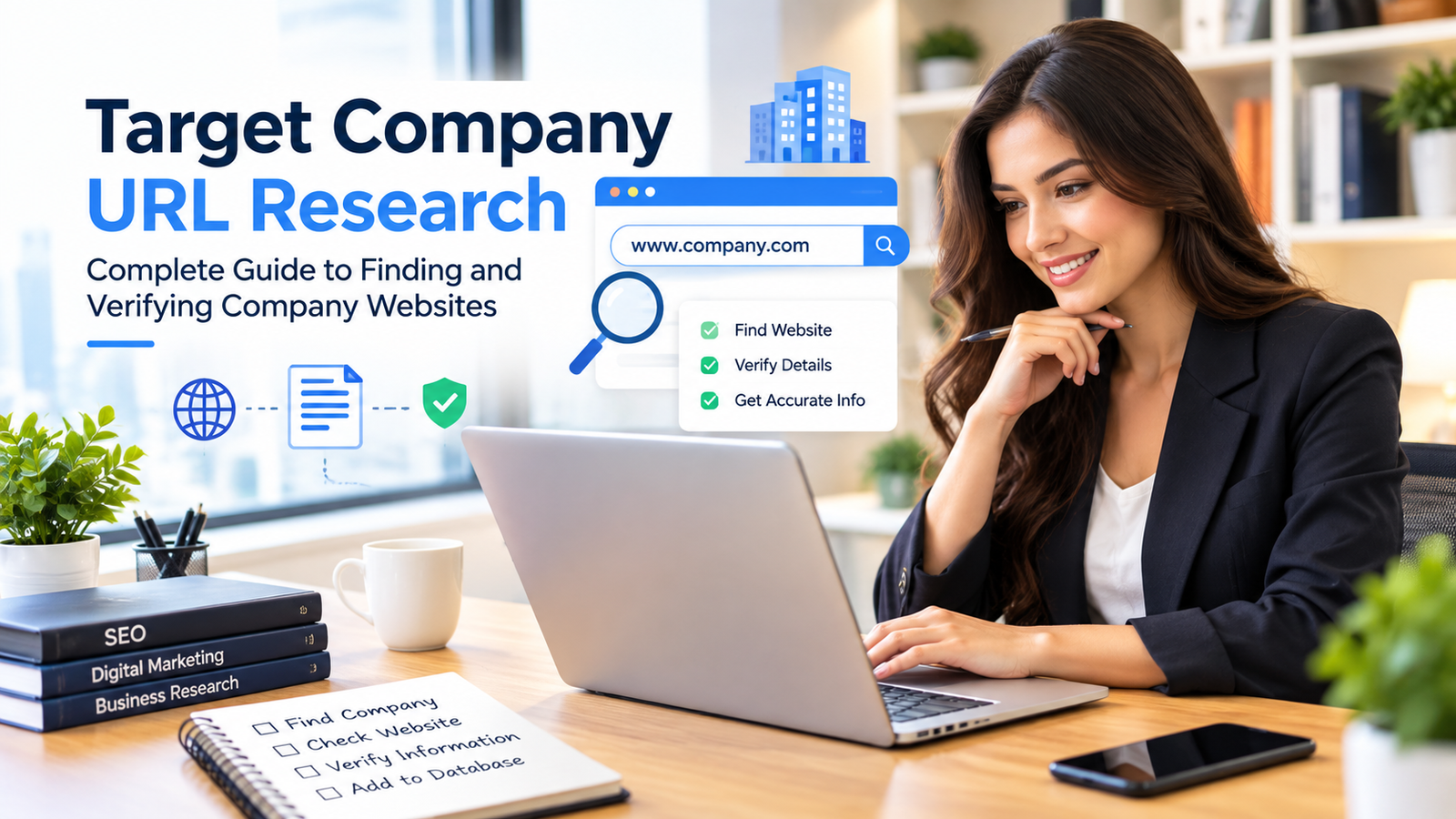
Target company URL research is the process of finding the correct official website for a business and confirming that it truly belongs to the organization in question. It sounds like a small task, but doing this accurately for hundreds or thousands of companies is far harder than it looks. A company’s website is usually the starting point for deeper research, whether that research supports sales prospecting, SEO competitor analysis, recruitment, or building a market intelligence database. This article explains what target company URL research involves, why it matters, and how professionals across different fields carry it out reliably.
What Is Target Company URL Research
Target company URL research means identifying the website tied to a specific company name and confirming that the website genuinely belongs to that organization rather than a similarly named business, a directory listing, or an unrelated page that happens to mention the name. The process usually moves from a company name to a possible URL, then to verification of that URL, followed by the collection of useful business data once the site has been confirmed. A sales team receiving a large spreadsheet of business names without any website addresses illustrates this well. Searching manually could take hours, so a faster domain lookup process is often used to identify likely matches, after which uncertain results are checked by hand before being added to a customer relationship management system. The goal is never simply to find a page containing the company’s name, since results often include directories, marketplaces, and unrelated organizations with overlapping names. The goal is always to identify the one official domain that truly represents the business.
Why Target Company URL Research Matters
A company’s domain works almost like its digital identity, and once confirmed, it becomes the foundation for sales prospecting, lead generation, competitor research, recruitment, account based marketing, business intelligence, and supplier or investment research. When the wrong URL is chosen, everything gathered afterward risks being attached to the wrong business entirely. Consider a researcher looking into a software company with a common name such as Apex, where a search may return several unrelated organizations sharing that word. Selecting the wrong website could mean recording the wrong industry, location, products, leadership, and contact details. This is why verification is treated as essential rather than optional, since it stops small errors from spreading throughout an entire research database.
Building and Cleaning the Company List
A reliable process usually begins with a clear list of businesses to research, ideally including country and industry details alongside the company name itself. This extra context is especially useful with common business names, since knowing that a company called Pioneer Solutions operates in software in a specific country narrows the search considerably. Before searching for domains, it also helps to clean and standardize company names, since messy input produces messy results. This often means removing unnecessary legal suffixes companies rarely display on their websites, while being careful never to strip away words that are genuinely part of the brand itself. At this stage, researchers also watch for spelling inconsistencies, duplicate entries, outdated names, and relationships between parent companies and subsidiaries.
Finding the Company Domain
Once the list is ready, the next stage involves discovering the likely domain for each business. Manual searching works well for small lists or unusual cases needing extra judgment, though it becomes slow once hundreds of companies are involved. Automated domain lookup tools accept a list of company names and return matching websites far more quickly, reducing a great deal of repetitive work, though any URL they return should still be treated as a candidate rather than a confirmed answer. Many of these tools also provide a match or confidence score to help prioritize which results deserve closer review. A high score only means a submitted name closely resembles something stored in the tool’s database, not that the website has actually been verified. Confidence scores help organize research efficiently, but they are never a replacement for genuine verification.
Verifying the Official Website
Verification is one of the most important stages, and it begins by opening the candidate website and examining it closely. The company name displayed should reasonably match the target business, allowing for minor differences between formal and informal versions of the same name. Branding can be compared against other trustworthy information already known about the company, while the About page usually offers confirmation through company history, headquarters location, mission, and the markets served. The contact page adds another layer through office addresses and business email addresses, and the products or services described should logically align with what the target company is known for. Legal pages such as privacy policies are often overlooked, yet they frequently reveal a company’s full registered name, which helps when a website only displays a shortened brand name. Wherever possible, this first-party information from the company’s own site should be trusted more than third-party directories, which can be outdated or incorrect.
Dealing With Similar Names and Regional Domains
Similar company names remain one of the most persistent challenges, since a single word can represent completely different organizations across finance, technology, manufacturing, and retail. Adding identifying details such as country, city, industry, product, or founder narrows the search considerably and makes it easier to land on the correct organization confidently. Regional websites add further complexity, since many global businesses do not rely on a single URL for every market. A company might maintain a global domain alongside country specific domains or regional subdomains. Deciding which version to record depends on the purpose of the research, since broad corporate research often favors the primary domain, while local sales or recruitment tends to benefit more from the regional version. Many researchers choose to record both together, which prevents useful geographic information from being lost later.
Tracking Rebrands and Domain Changes
Businesses change over time, and they may rebrand, merge, get acquired, split into separate entities, or migrate to a new domain while redirecting the old one. When an old website automatically forwards visitors to a new brand, it is worth investigating the reason rather than assuming the old URL is still the best record. This might reveal that the business was renamed, acquired by a larger organization, that only the website changed while the company remained the same, or that the original brand continues operating separately. Recording these changes carefully is valuable for historical accuracy and for keeping a customer relationship management system dependable over time, since outdated domains that go unnoticed can quietly damage an entire database.
Applications Across Sales, SEO, Recruitment, and Market Research
Verified company domains support a wide range of activities once confirmed. Sales teams use them as the starting point for studying a prospect’s product pages, industry pages, and newsroom announcements, allowing outreach to feel personalized rather than generic. SEO professionals rely on verified competitor domains for keyword gap analysis, backlink research, and content research, since comparing performance against the wrong website can distort an entire competitive analysis. Recruiters use confirmed websites to locate official careers pages directly, reducing the risk of relying on outdated third-party job listings. Market researchers studying an entire industry benefit from verified domains for many companies at once, allowing direct access to first-party information about products, pricing, geographic presence, and leadership that supports stronger industry reports.
Maintaining Accurate Data Over Time
Finding a URL is often only the beginning, since verified websites can be used to enrich a company record with headquarters location, countries served, company size, social profiles, and parent company relationships. This turns a simple list of names into a genuinely useful business intelligence resource. A database only stays valuable if maintained properly, though. Recording a verification status and the date a company was last checked allows teams to judge how trustworthy each record remains, and high value accounts deserve periodic rechecking, since rebrands and domain migrations happen more often than expected. Researchers should also stay cautious about relying too heavily on artificial intelligence tools, since these can speed up name cleaning and initial matching but may still confuse similarly named businesses or rely on outdated information. For research that carries real business value, checking the final result against the company’s current official website remains an essential last step.
Conclusion
Target company URL research may look like a minor detail buried within a larger workflow, but it quietly shapes the accuracy of everything built on top of it, from sales outreach and SEO competitor analysis to recruitment research and market intelligence. A single incorrect domain can send an entire research effort down the wrong path without anyone realizing it until the damage has already spread through a database. The most dependable approach combines the speed of automated discovery with the careful judgment of human verification, particularly for ambiguous company names, regional websites, and businesses that have recently changed. By treating the official company website as the primary source of truth rather than depending entirely on directories or unverified match scores, researchers and businesses can build cleaner, more reliable data that supports every decision made afterward.
